Shirley Kelly
CSM President, 2000-2006
Vice President of Instruction, 1992-2000
Shirley J. Kelly was CSM’s eighth president, serving from 2000 to 2006 after being vice president of instruction. She bridged the college’s past to new ways of teaching, learning and service that emerged in the late 20th century out of research data; a diversifying student body and the growing role that community colleges play in meeting student needs.
Kelly built CSM’s first new major building since 1963, the Integrated Sciences Building, to embody these new ideas about higher education. She led CSM’s first big push into learning communities, now a signature feature of the college. Recognizing the need to house CSM’s expanding student services under one roof, Kelly and VP of Student Services Pat Griffin also launched the long drive to plan and fund today’s College Center, Building 10, completed four years after their retirements.
Kelly achieved her goals through her quiet ability to get people to work together, said Gus Petropoulos, former assistant chancellor for research and technology at the San Mateo County Community College District.
“People will work together, but they need a kindred soul to support them in doing that,” Petropolous said.
Kelly began her career teaching chemistry at City College of San Francisco. Her mentor Pete Mueller, later co-author of the influential Siemens-Mueller study of teaching loads, wanted chemistry to get a larger share of the college budget and asked Kelly to compile data in favor. Jules Fraden, CCSF’s then-VP of instruction, made similar requests.
“Much later I realized that Jules had been doing me wonderful favors by allowing me to learn a lot of stuff,” Kelly said. “I thought he was piling on work.”
In fact, she was gaining valuable insight into college-wide operations, especially as she took on IT work and other duties that fell outside departments. Kelly became CCSF’s assistant dean of math, science and engineering, then its vice president of instruction in 1985.
“I had been attracted to CSM from the late 1960s,” Kelly said. “My husband, Mike, went there. He was one of the people who helped move it from Coyote Point to the current campus. He helped move the chemistry storeroom up here, picking up beakers, boxing them up and putting them on the truck.”
“When I became president and was first installed in my brand-new office, Michael came up to see me and I said, ‘Look, Michael, this is Julio Bortolazzo’s desk.’ He said, ‘I know that. I moved it up from Coyote Point.’”
As education evolves, so must its environment
John Carl Warneke’s College Heights campus, opened in 1963, was aging by the 1990s, both structurally and conceptually. Research had shown since the campus was built that students often learn better doing joint projects in small groups, which CSM’s buildings didn’t accommodate. For example, the math classrooms all had 36 seats bolted to the floor, facing straight ahead and unable to be added to or moved, recalls retired math Professor Bill Rundberg. And while Warneke’s plan called for an astronomical observatory to support science classes, only an empty dome was completed.
“When Shirley saw the potential of what could happen with the science building, she corralled the money to make it happen,” Petropolous said.
Kelly calls its opening “an extremely special moment.”
“It felt like a couple of bookends. I had come here when I was still a CCSF chemistry teacher to see the ‘new’ existing science building. The last thing I did before I left was cutting the ribbon at the new science building. Having been a chemistry teacher, it was very, very gratifying.”
New learning modalities
Kelly fostered innovative learning in other ways. As vice president of instruction, Kelly formed Middle College High School, which now serves some 300 students a year. She added resources to CSM’s first learning communities, including Puente and Umoja. Today, learning communities are a distinctive feature of CSM.
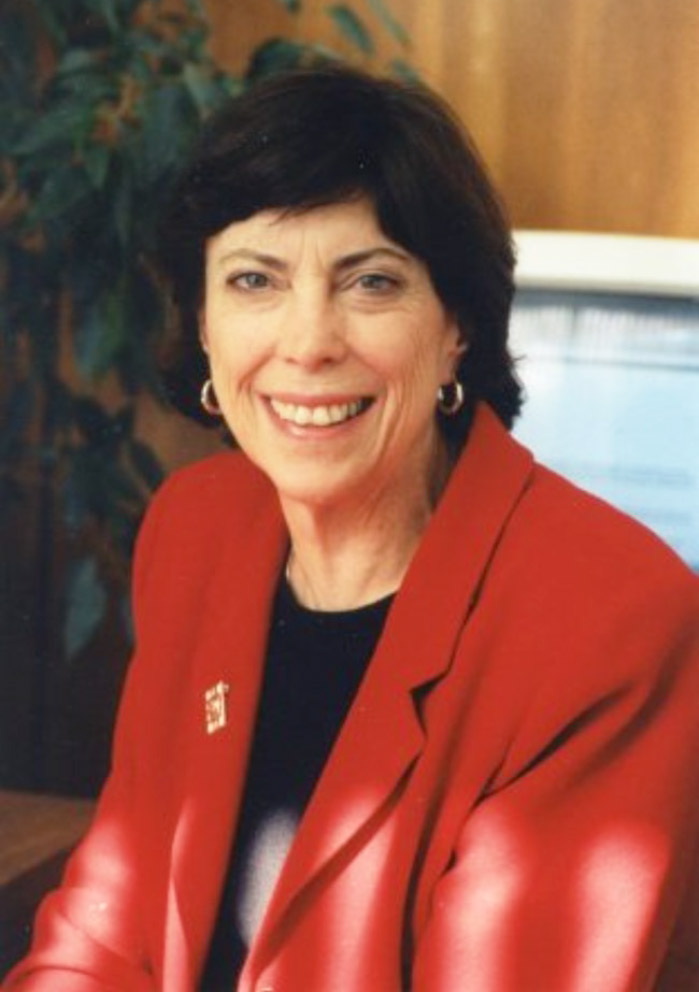
CSM President Shirley Kelly circa 2002. CSM Historical Photograph Collection
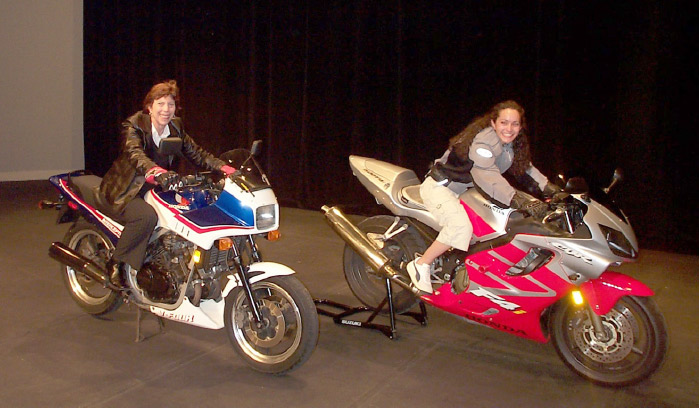
Shirley Kelly, left, with Candice Alfaro, president of CSM’s Associated Students, on motorcycles borrowed for a campus event. Photo courtesy Shirley Kelly.
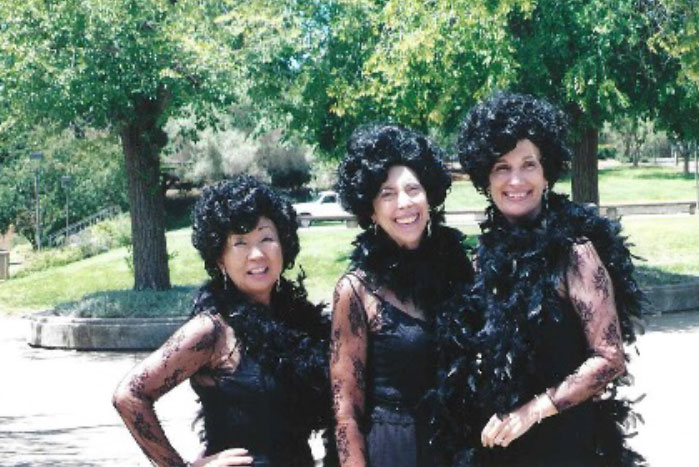
From left, CSM VP of Instruction Grace Sonner, CSM President Shirley Kelly and VP of Student Services Pat Griffin perform as the Supremes at Classified Staff Appreciation Day 2002. The event highlighted the first time in CSM history that all three top administrators were female. Photo courtesy Pat Griffin
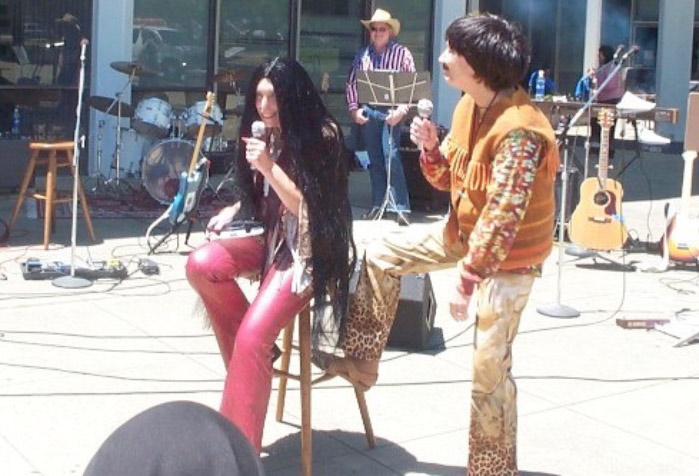
CSM President Shirley Kelly, left, and VP of Student Services Pat Griffin perform as Cher and Sonny at Classified Staff Appreciation Day 2003. Photo courtesy Shirley Kelly
“It just seemed the right way for students to learn,” Kelly said. “Students in them feel more connected to the institution, which you always want. They also tend to do better in subsequent connections.”
“It’s an expensive model. In tight budget times it’s hard to maintain. It calls on a huge dedication from the staff and the faculty, because you’re coordinating all the lectures and assignments with someone else.”
Moving into the presidential role
Kelly said it was never her goal to be CSM president. “I had a good job,” she said. “I was bereft when I learned that Peter Landsberger was leaving. We had had a wonderful working relationship. I kept thinking, ‘I don’t think I’m the president type ... I’m a shy person.’”
“But I remember thinking: If someone gets the job whom I don’t like and I have to leave, I would never forgive myself for at least thinking about it.”
Once she became CSM’s president, Kelly attended a three-week Harvard training program for college presidents. “I wrote this letter: ‘Dear Harvard, Help! I’m like a deer in headlights.’”
She looked at her presidential predecessors, seeking lessons for her new role.
“I talked to Betty Roehr, the daughter of CSM’s first president, Charles S. Morris. Until he died, I talked to Julio Bortolazzo every six months or so. Even though he went other places, his proudest accomplishment was the establishment of CSM. He told me, ‘Now, this is what you do to get the attention of faculty: You call them at 7 am. Because they tell you the truth when you wake them up.’”
Kelly also actively supported the goal of a new building designed to house student services that were scattered across the campus and housed in less than satisfactory circumstances. That building, College Center Building 10, opened in 2011.
Tough choices and a learning curve
“There were some programs here that were not doing very well,” Kelly said. “Some needed beefing up, others discontinuing. But if you’re in a multi-college district you can’t just add and subtract programs without thinking how it will affect the other colleges.”
KCSM-TV, for example, took an inordinate amount of energy. Even after the station’s costly conversion to color in the 1980s and to digitization in the 1990s, its expenses mounted.
“The TV station was unable to sustain itself,” she said. “We looked at ways to make it more cost-effective. One way was to cut back the reliance on PBS. Arcane rules in a multiple-station market governed how we had to behave ... Marilyn [Lawrence, KCSM’s general manager] was very honest. She said, ‘You don’t know anything about my business, and you’ve got to learn.’”
“When I was out in the community, it was something people talked to me about. ...The problems came from the other two colleges. They saw it as a resource devoted solely to CSM, using money that could have gone to them. They were more vocal about it than anyone on [the CSM] campus.”
Eventually, in 2018, the college district sold the television station.
CSM’s Supremes
Despite her professed shyness, Kelly is remembered in some quarters for quite an opposite role—that of performing artist.
In thanks to the hard-working classified staff who keep CSM running, Kelly and Griffin instituted a yearly Classified Recognition Day with food and live entertainment.
“One year, Grace Sonner, then vice president of instruction, came to Shirley and me and said, ‘We three are going to be the entertainment,’” Griffin said. “Shirley and I looked at each other and then looked at Grace. As far as I knew, none of us was known as a dancer or singer. But Grace thought it would be great if we impersonated the Supremes.”
“Grace chose a couple of songs that we all learned so we could lip-synch the words, and she devised a little choreography routine for each song,” Griffin said. “I had had some dance lessons as a kid, so I relatively quickly got into it. Shirley, on the other hand, was considerably more reluctant. But there was no resisting Grace. She got us wigs and black lace outfits, and the CSM Supremes were born.”
“We opened with ‘Stop! in the Name of Love.’ We cracked up the classified staff. They just could not believe that the three senior administrators—lacking any real talent—were willing to get out there and do that.”
The performance also sent a powerful message: It drove home that for first time in CSM history, all three top administrators were female.
After Grace retired, the request for administrative entertainment continued. Kelly was Cher in 2004, while Griffin was Sonny. A faculty rock band was added, featuring future President and Chancellor Mike Claire. In 2006, the year Kelly and Griffin retired, they performed their last gig as the Blues Brothers.
“I never was tired of being CSM president,” Kelly said. “My husband had retired, and he was interested in doing some traveling.”
“Do I have regrets? None about leaving,” she said. “I had a good successor in Mike Claire. I would have liked to see some global-type education, more online courses.”
“It might have been fun to be around for more of the new buildings.”