Learning Communities
Some of CSM’s happiest students belong to these holistic campus ‘families’
Some of College of San Mateo’s happiest students belong to its learning communities, innovative cultural or affinity groups that confer support and care.
CSM’s nine learning communities range from Latinx-oriented Puente and Black-oriented Umoja to Writing in the End Zone for football players and Project Change for justice-impacted students. They offer cohorted class sequences as well as dedicated counselors and inspired faculty who go to great lengths to empower students.
“These communities work because they are community within a community, a small version of a family,” said Tarana Chapple, CSM Dean of Academic Support and Learning Technologies. “They look at the student holistically, addressing the social, cultural and financial aspects of whatever they may need. Through their safety and mutuality, learning communities fight the alienation that students from underserved populations may feel in institutions where they may not feel seen or heard.”
The communities average 30-40 members. They are often student-initiated, arising from clubs and interest groups. For example, Katipunan, CSM’s learning community for Filipinx students, began as a club that drew strength from the Stop Asian Hate movement. CSM’s new learning community-in-progress, Brothers Empowering Brothers (BEB) for men of color, began as a club inspired by President Obama’s initiative My Brother’s Keeper. As well as cohorted courses and social events, learning communities offer leadership and service opportunities and special counseling hours. In 2022, CSM obtained funds to dedicate a counselor full-time to its learning communities. She works near The Village, the meeting space in Building 17, CSM’s Center for Equity, Leadership and Community Building, that CSM’s learning communities call home.
CSM President Jennifer Taylor-Mendoza, whose Ph.D. dissertation affirmed learning communities’ benefit to Black students, has expanded and enriched CSM’s communities both in her current role and as Chapple’s predecessor. In addition to Katipunan and BEB, communities launched on Taylor-Mendoza’s watch include IX in Action, a community for female student-athletes.
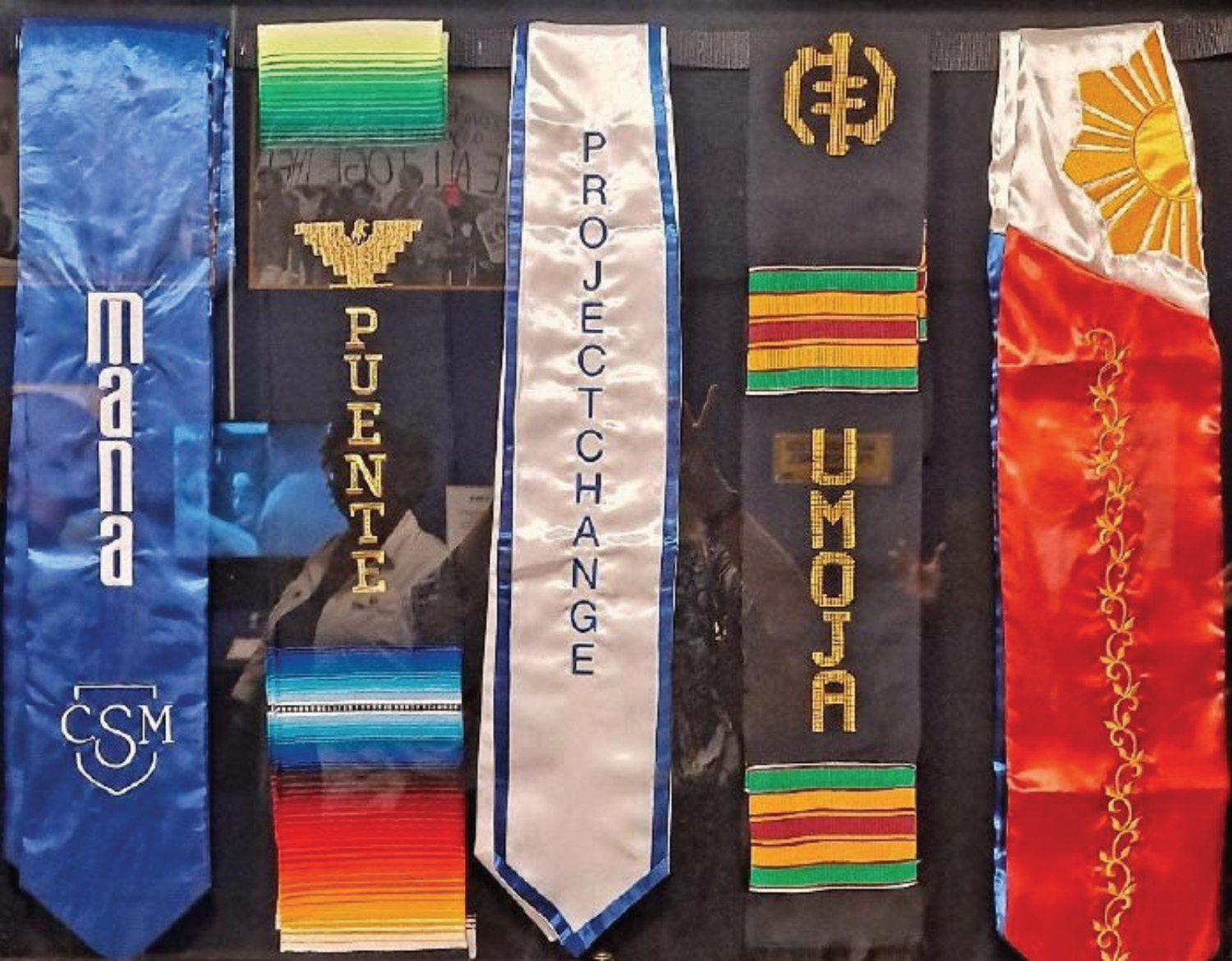
Members of CSM’s nine learning communities proudly wear identifying stoles at graduation. Some are seen here:
from left, Mana for Pacific Islanders; Puente for Latinx learners; Project Change for students impacted by the justice
system; Umoja, for African-American students; and Katipunan, for Filipinx learners.
Photo: Barbara Wilcox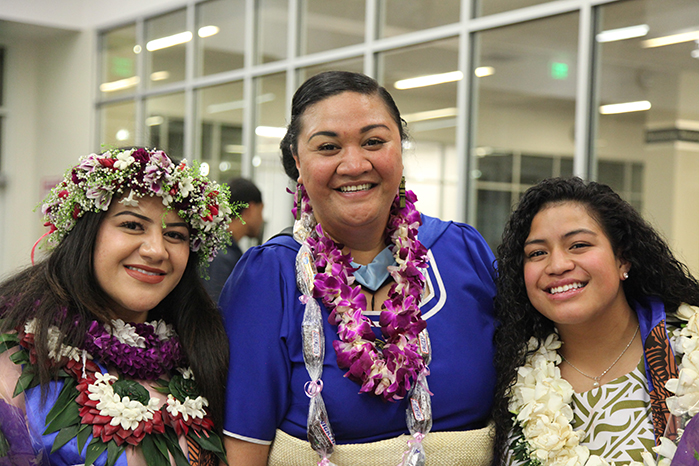
Mana learning community graduates with Mana Coordinator Fi Tovo (center).
In many ways, the communities trace back to one of America’s first such programs founded here at CSM, the heavily student-directed College Readiness Program (CRP) launched in 1966. Krystal Duncan, CSM’s Dean of Counseling and a huge advocate for learning communities at CSM, credits many CRP alums as mentors when she came to the campus in the 1990s. Ethnic Studies Professor Rudy Ramirez, the last College Readiness Program alumnus still teaching at CSM, carries his passion for empowerment into the learning communities. Through Project Change, Ramirez and others share the beauty of learning with 70 currently or formerly incarcerated students.
“My whole life I really hated school. It was a place where I always felt I was going to get punished,” said Nick Jasso ’19, UCLA ’21, a Project Change alumnus who entered CSM after juvenile hall and now works as the community’s coordinator.
“Rudy Ramirez and (former sociology Professor) John Stover took a lot of time out of their schedules to show me how to do everything,” Jasso said. “I’d never written an essay. Rudy sat down with me and taught me how to write in MLA format. Stover taught me how to do research.”
“Through Project Change, I realized that college had incredible resources for my benefit. In addition, I learned that the qualities that had gotten me into trouble—the talking back, the defiance—could become positive qualities of leadership and critical thinking given the right development.”
Starting at CSM, Jasso studied abroad in Florence, Italy; he spoke before Gov. Jerry Brown to advocate for funds for incarcerated learners; helped lobby for $15 million annually to scale Project Change statewide; began the academic groundwork to become a counselor; and found his unique voice.
All that happened, Jasso said, “because when I came here, right away I knew I had a web of support.”
While CSM offers many services for students hindered by systemic inequity, assisting them with transportation, food, textbooks, and other material needs, Duncan said CSM’s learning communities are uniquely valuable because they are based in the classroom.
“Although we have a great number of Student Services programs that provide access and support, what we learned is that these supports did not extend into the classroom,” Duncan said. “Through learning communities we serve students holistically. Instruction and Student Services partner in providing what each student needs to be successful inside and outside the classroom.”
As a result, students in learning communities find strength in their shared experience.
“First and foremost, the learning community gives them a home away from home inside an institution where they are one of the smaller racial groups on campus,” said English Professor Jeramy Wallace of Umoja’s African-American students. They’re learning about leadership in a space free of identity threat.”
Curricula can be customized as well. For example, members of culturally based learning communities study writers of their own heritage to learn universally applicable, university-level critical skills.
“More than likely the standard curriculum is Eurocentric, and more than likely it privileges affluent white voices,” Wallace said. “There’s a tokenization of black thinkers and writers. Your teacher tries to tell you that Martin Luther King was fighting for colorblindness.”
In contrast, Wallace’s section of English 105 uses folktales, fables, and works by African griots to examine “how communities of color can use stories to resist and dismantle dominant narratives.” Students read peer-reviewed scholarly articles by Black authors. Wallace’s section of English 110, Literature and Critical Theory, studies Black writers from the Harlem Renaissance onward, examining, he said, “the legacy of African-American literature and how it came out of a place of social justice and a fight for liberation.”
Metrics support the learning communities’ approach. For example, a 2007 study found that Writing in the End Zone students completed developmental English (English 828) at a rate 20 percent higher than the student body at large. In 2022, the Campaign for College Opportunity recognized CSM for placing 100 percent of its African-American students in transfer-level English their first semester, with 70 percent of them doing well enough to progress in the transfer sequence.
Plans include a second cohort for Puente, one of CSM’s most popular learning communities, and launching Math in the End Zone to boost student-athletes’ transfer potential in STEM fields.