Lois Callahan
First female president calmly steered CSM through multiple crises, then was named the college district’s first female chancellor
Lois A. Callahan, College of San Mateo’s first female president, was a calm but formidable leader. She steered the College through multiple and often simultaneous crises, including Proposition 13 funding cuts; the imposition of student fees; the 1989 Loma Prieta earthquake; a federal lawsuit over lack of child care; a racism scandal involving a student publication; and a labor dispute that closed cafeterias at all three district campuses for nearly three years.
Any one of these PR bombs could have derailed a lesser leader. Callahan’s nimble handling of the challenges no doubt figured into the district trustees’ decision in 1991 to name her the San Mateo County Community College District’s first female chancellor at a time when female leaders were few.
Barbara Christensen, the district’s former director of community and governmental relations, said of Callahan on her death in 2007: “She was the most totally focused and task-oriented person I know and had a work ethic beyond anyone I've ever seen before.”
Callahan worked well with CSM students and treated them with respect. She was also a mentor, Christensen said, to many women trying to advance their careers: “She always had time and gave time to help other people.”
Born in Gary, Indiana, Callahan received a bachelor's degree in business and education from Southwest Missouri State University, which later named her its alumnus of the year. She began her career as a high school teacher, then earned a master's degree in business education from Chico State University and a doctorate in higher education administration from the University of Southern California.
She taught business at UC Berkeley, San Francisco State University, Cal State East Bay, and from 1968 at CSM, where she rose through the administrative ranks to become Director of Cooperative Education and Dean of Instruction.
A challenging entrance to college leadership
In September 1978, Callahan was named CSM's president, becoming one of the state's first female community college presidents. It was just three months after the passage of state Proposition 13, which by capping property taxes, forced dramatic cuts to public services, including education. Some changes during this time, such as the imposition of tuition, took more than 40 years to reverse.
In April 1981, Callahan and the Faculty Senate convened a task force that suggested terminating several departments, including education—which went to other district campuses—and training for commercial pilots and building inspectors. Ethnic studies and anthropology were reduced, while men’s varsity basketball was eventually eliminated. From 1980 to 1984, according to the San Matean, more than 400 classes were cut or moved to other district colleges.
By 1984, CSM students were being nickeled and dimed by fees, while 160 more classes were cut and enrollment declined 8 percent over the previous academic year. They paid materials fees ranging from $2 to $90; parking fees of $15 per semester; and $10 to drop a class.
“These fees act as a deterrent,” Callahan told the state Assembly. “I don’t want to see the community college system turned into a collection agency.”
She helped lobby the state Legislature for hundreds of millions of dollars in additional funding for all the state’s community colleges.
In February 1984, Gov. George Deukmejian signed a bill imposing $50 tuition effective that fall and providing $96.5 million to the colleges for the rest of the 1983-84 school year. The funding enabled CSM to eliminate ten nonacademic fees.
Complex negotiations, fancy faculty teas
To preserve KCSM-TV as a unique resource, Callahan oversaw its costly and complicated switch to color broadcast. She began the implementation of shared governance, a statewide community college reform written in part by future CSM President Peter Landsberger. When CSM student parents took their quest for affordable child care to federal court, Callahan worked with the parents of a former student to fund what became the Mary Meta Lazarus Child Development Center.
In some ways, despite her pathbreaking resume, Callahan was old-school.
“Dr. Callahan would always have a very elaborate Christmas tea for the faculty,” remembered former Evening College employee Joan Bell. “I was told to wear a white blouse and black skirt and serve the tea.” Callahan also hosted a yearly Senior Citizens Day, in which 250–300 seniors, primarily ladies, would convene on campus to get free hairdos from Cosmetology, watch a fashion show and have lunch preceded by a presidential welcome.
Several retirees remember Callahan’s noteworthy presence during the 1989 Loma Prieta earthquake, which struck at 5:04 p.m. CSM’s other administrators had left for the day, these retirees said: It was Game 3 of the World Series.
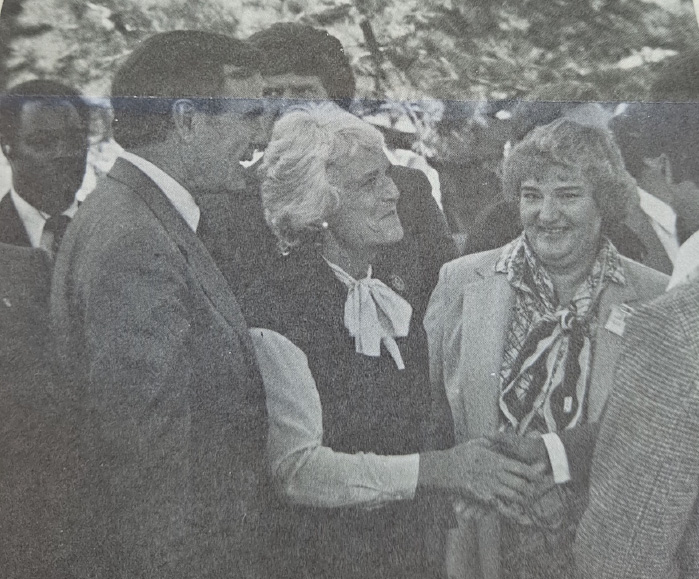
Callahan, right, with future U.S. President George H. W. Bush and his wife, Barbara, as they visit CSM during Bush’s 1980 vice-presidential campaign. San Matean/CSM Library
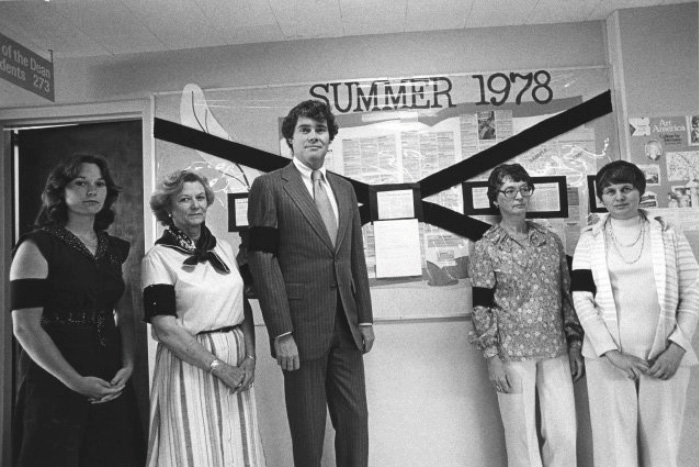
CSM administrative staff in summer 1978 wear black armbands stating their opposition to Proposition 13, the state initiative that capped property taxes and led to cuts in education spending. It fell to Callahan, named CSM’s president that September, to levy the cuts. From left, unidentified; Martha Betz; Michael Kimball, Director of Continuing Education; Betty Schoenfeld, Evening College Office; Joan Bell, Instruction Office. Photo: CSM Historical Photograph Collection
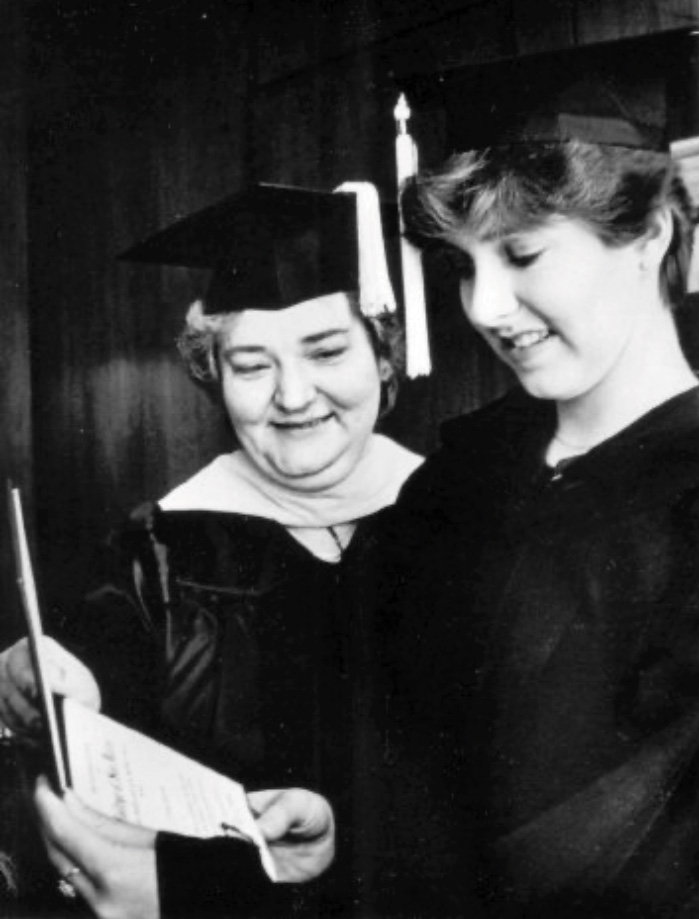
Callahan at daughter Kristel’s CSM graduation in 1980. Photo: CSM Historical Photograph Collection
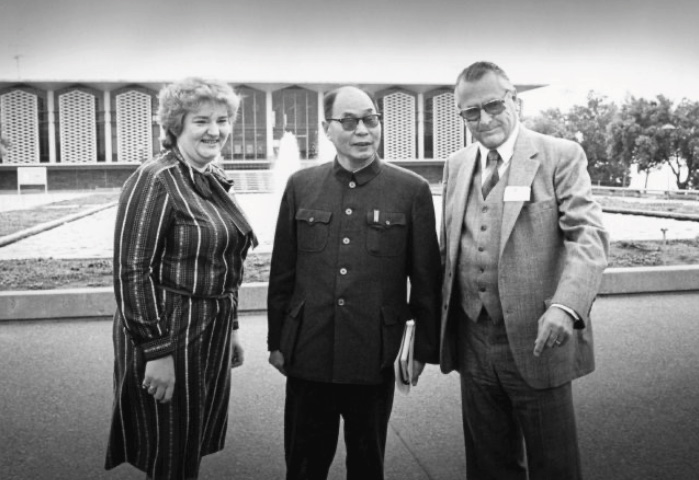
Callahan with SMCCCD Chancellor Glenn Smith and a visitor from the People’s Republic of China’s Ministry of Education in 1979-80, around the time the PRC and United States normalized diplomatic relations. Soon after, some of mainland China’s very first U.S. students enrolled at CSM. In 1991, Callahan succeeded Smith as chancellor. Photo: CSM Historical Photograph Collection
“There was an exercise class for staff at 4:30,” remembered former Evening College employee Joan Bell. “Suddenly, we felt the ground moving. The water in the pool was going like this [waving her arms]. The lights were swaying ... I looked at the cars outside and realized there were no administrators on campus. The parking lots were empty.
“I thought, ‘I’d better go to the office.’ ... The phones were ringing off the hook ... We had to decide what to do. Dr. Callahan had been over at KCSM. She came back.”
“I was in Building 1 at a CSEA (union) meeting,” said former Theatre Manager Helen Souranoff. “I ran out to check on my student assistant in Building 9. There were waves in the fountains. It was surreal. I went back to Building 1, and Lois Callahan was upstairs at the Evening College. She said, ‘Evacuate the campus.’”
After a thorough inspection, CSM reopened several days later, though people remember Highway 92 to campus being closed for a week or more.
Censorship is ‘inappropriate,’ standards are necessary
On September 22, 1989, the student publication Monday Morning Blues published an anti-Asian article under the pseudonymous byline “Jubal Early,” detailing the author’s breakup with an Asian girlfriend. Its title: “Who Do You Hate?” The resultant uproar included a protest by 400 CSM faculty and students and news coverage from as far away as Japan.
Callahan called the piece “embarrassing and hurtful” but said censorship of a student publication was “inappropriate.” She sat front row at the student-led forum on racism that followed the protest. Both the Blues’ editor and its faculty adviser kept their jobs after agreeing to editorial standards, including a rule that contributors use their real names.
While this was happening, a districtwide labor dispute shuttered the cafeterias on all three campuses. Callahan welcomed student Senator Karl Ferguson’s fortuitous pitch for Café International, a pop-up student-run coffeehouse in the space where the Health and Wellness Building now stands. Callahan contributed start-up money from her reserve to open Café International, which launched in October 1989 and pulled in thousands of dollars a week until its closure circa 2006. Ferguson deplores any hint that the café was used as a wedge in contract talks, but for two years it was the only place at CSM to buy food not out of a vending machine. When Ferguson graduated, Callahan made him the College’s first student graduation speaker since the unrest of the 1960s.
In September 1991, Callahan was named chancellor of the San Mateo County Community College District, serving in that role until her retirement in 1997. Gov. Pete Wilson and California’s congressional delegation hailed her as an “exceptional chancellor” for guiding the district through a difficult period.
Callahan later served as interim chancellor of the West Valley-Mission Community College District, the Foothill-De Anza Community College District and the Contra Costa Community College District, as well as interim president of Las Positas College and the College of Marin. She died in 2007, weeks after a diagnosis of cancer.
Callahan is enshrined in the San Mateo County Women’s Hall of Fame. The Lois A. Callahan Scholarship is given each year to a CSM student in business, math or computer science, with special consideration to female applicants.