Help with Sky-high Rents
College of San Mateo was the first California community college to host subsidized employee housing, now at all three district campuses
San Mateo County Community College District employees can get help with the Bay Area’s stratospheric housing costs through innovative programs, including 134 district-owned housing units for faculty and staff.
Though many four-year colleges offer subsidized housing for faculty and staff, the San Mateo County Community College District became the first two-year institution in California to do so by opening its College Vista apartments at CSM in 2004.
This housing is the legacy of Barbara Christensen, the district’s former director of community and government relations, who became concerned in the early 2000s about staff recruiting and retention problems due to Bay Area housing costs.
“I had learned that the Santa Clara Unified School District had built housing for faculty,” Christensen said. “I went down there and asked how they did it, and learned that they did this on their own.”
For a site, then-Chancellor Ron Galatolo suggested an underused parking lot next to the CSM campus, below the district office. On it, the district built today’s 44-unit College Vista apartment complex.
As of March 2023, base rents at College Vista range from $1,175 for a one-bedroom unit to $1,850 for a three-bedroom, set several years ago in line with San Mateo County’s below-market-rate index for very-low-income housing. Views, garages, and other amenities are slightly more.
“The amount of money that we saved allowed us to buy our first home,” said David McLain, a CSM marketing staff member who lived at College Vista for several years. McLain is one of about 50 district employees who have transitioned to homeownership from district-owned housing since the program began.
Cañada Vista opened at Cañada College in 2010, while 30-unit College Ridge near Skyline College in San Bruno opened in February 2023. Any full-time district employees may apply to live in any of the complexes if they meet the definition of first-time homebuyers under the federal rules for that program.
Employees may live in a unit for seven years, during which time the district advises they save up for the transition to market-rate housing. In addition, the district can help them buy a home with a second loan and a closing-cost grant.
“It’s nice because we’ve been able to expand our living environment as our family has grown,” McLain said.
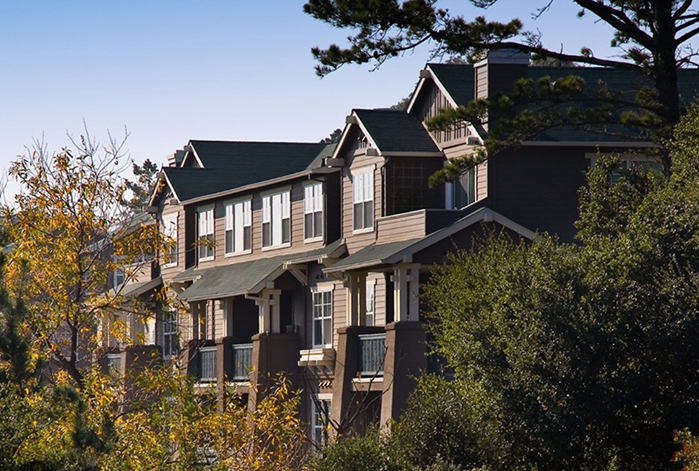

Unlike other campus buildings, the district’s apartments had to go through local city planning processes for housing projects. Christensen had no experience as a developer. But in her role leading the district’s external relations, she had many contacts and great expertise working with people and local governments to advance the district’s goals.
“The city of San Mateo was enthusiastic,” she said. “It was a simple task.” After meeting with neighbors and resolving their aesthetic issues, she said, “there were no issues at all. It’s adjacent to another apartment project. There’s no single-family housing around it.”
The district issued debt for the $8.6 million project as a certificate of participation to be repaid from rent revenue over 30 years. Developer Thompson/Dorfman of Mill Valley covered conceptual and design work, building permits, and construction. The architect was KTGY Group of Irvine. BUILDER Magazine awarded College Vista its Best Affordable Attached Project of the year.
Almost immediately, College Vista had a long waiting list. Christensen was eager to build housing at the district’s two other campuses. These, she recalled, were more challenging.
Cañada Vista’s 60 apartments, for example, were planned on a district-owned parking lot within the town of Woodside, which then had no multifamily housing.
“I had to go to the Woodside Town Council and ask them to de-annex the land and give it to Redwood City,” Christensen said. “Which they did. Then we had more neighborhood disruption about that.”
The site, like College Vista in San Mateo and College Ridge in San Bruno, is on a hill and has commanding views.
“Neighbors said, ‘People are going to be able to see into my backyard.’ And the officials and the council in Redwood City listened to them and considered it all very carefully and said, ‘No, they won’t.’”
As soon as Cañada Vista was completed, the district started working on housing at Skyline. This project, Christensen said, was complex because the property was surrounded by single-family housing, making approval more challenging. The district sold the land to a private developer, but retained its own architect and builder.
Christensen said she retired the day after receiving approval for the Skyline project, feeling she had made her mark.
“You hire the best. And they handle the details,” she said. “I just had to handle the politics.”
Today, she said, College Heights is almost paid off. Tax-free financing has paid for the construction, and rents are paying off the bank loans—$8.6 million in all. After that, the rents will help subsidize the college district. A separate, nonprofit Educational Housing Corporation with a board of directors appointed by district trustees handles management issues such as eligibility and rents.