Jennifer Granholm (Class of 1978)
U.S. Secretary of Energy, 2021-present
Governor of Michigan, 2003-10
Jennifer Granholm has risen higher in U.S. government service than anyone in College of San Mateo’s long history. As President Biden’s Secretary of Energy, Granholm is tasked with leading the United States into a future of sustainable energy and green jobs and overseeing its nuclear capability. As governor of Michigan from 2003 to 2011, during the Great Recession and the bankruptcies of Chrysler and General Motors, Granholm initiated the state’s pivot to becoming a center of economic innovation.
Her tenure in Michigan, as she fought to stem the state’s hemorrhage of low-skilled manufacturing jobs to overseas plants, was deeply challenging. In her autobiography, she describes how painful it was to realize that her policy changes would not bear full fruit until long after her term ended.
“My ego blocked my ability to accept the reality,” she wrote in her 2012 book, A Governor’s Story. “I would not be able to carry Michigan on my back to the victory circle. I would not be in office to pop the champagne cork as we crossed the finish line. I had to be okay with that.”
But she learned, she said, to remain a fighter and to empower people to create, innovate and learn.
Granholm’s career might surprise many who knew her at CSM in the late 1970s. Born in Canada and raised in San Carlos, she acted and modeled as a teen and competed in pageants, winning Miss San Carlos and Miss San Mateo County. At CSM, she studied drama with Professor Jane Griffin and acted in Years Ago and The Barretts of Wimpole Street.
In 1978, Granholm won a two-year scholarship to the American Academy of Dramatic Arts in Pasadena, California. During her brief stay in Hollywood, Granholm began reading about politics and economic activism, “marinating in me a desire to change the world.” She became a U.S. citizen, enrolled in UC Berkeley and then Harvard Law School, moved with her Michigan-born husband, Daniel Mulhern, to Detroit. She became a federal prosecutor and then Michigan’s attorney general. Yet her dramatic training would play a key role in her political career.
While she was governor, in 2008, then-vice presidential candidate Joe Biden was preparing to debate his GOP rival, Alaska Gov. Sarah Palin. He asked Granholm to portray Palin, whom she knew from governors’ networking events, in his staff’s detailed rehearsals of the televised event. Staffers feared Biden might condescend to the less experienced Palin, putting off women voters. Granholm took part in three mock debates in character as Palin, copying her mannerisms down to the tilt of the head.
The prep helped make Biden’s debate night a success. More important, Biden and Granholm forged a lifelong bond over their shared interest in energy innovation and the need for federal leadership in trade policy, attracting foreign investment in U.S. industry, and post-industrial job retraining.
As governor, Granholm hammered the Bush administration for not enforcing trade agreements meant to stimulate U.S. exports.
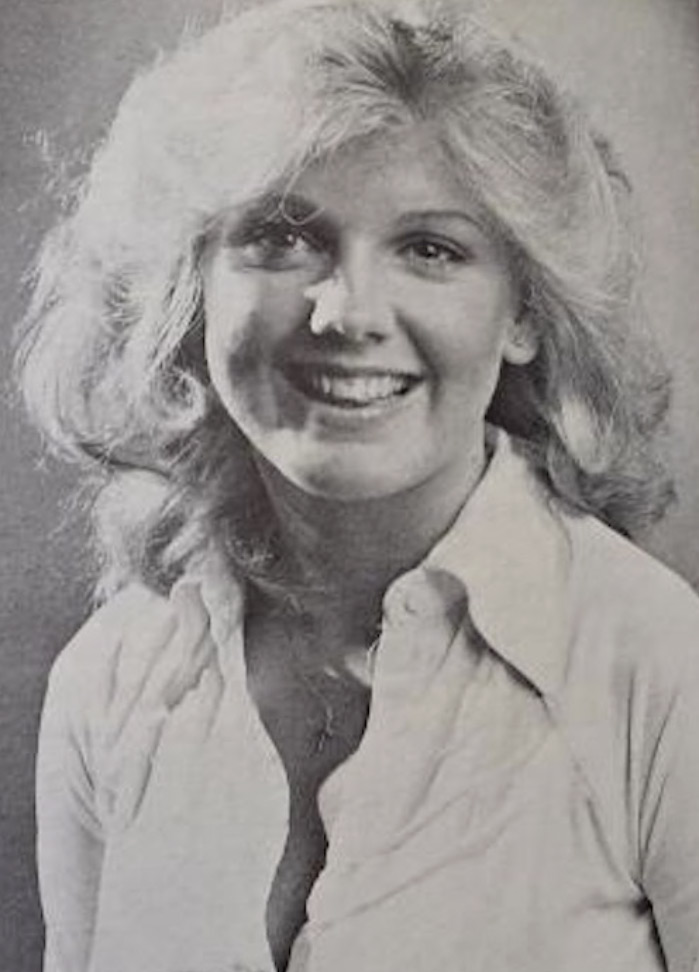
CSM theater major Jennifer Granholm in 1978, the year she won a scholarship to the American Academy of Dramatic Arts in Pasadena, Calif. Thirty years later, her acting skill helped Joe Biden triumph in his vice-presidential debate with GOP rival Sarah Palin. Photo: San Matean/CSM Library
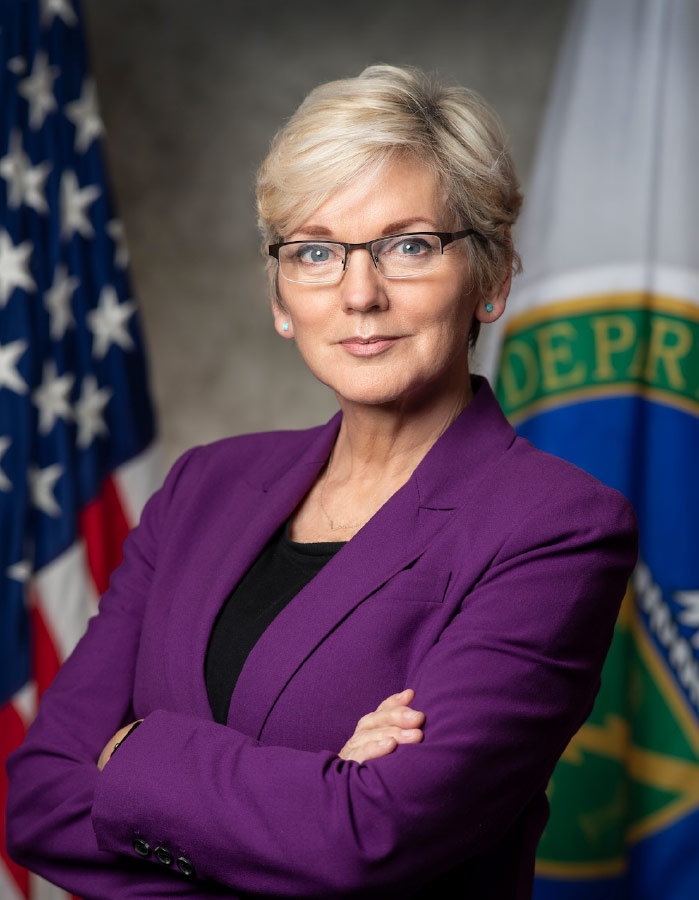
Granholm in 2021 as President Biden’s Secretary of Energy. Photo: U.S. Department of Energy
“NAFTA and CAFTA (the Central American Fair Trade Agreement) have given us the shaft-a,” Granholm told an interviewer in 2006. She believes the U.S. government must work harder to offset practices in other countries that make manufacturing there much cheaper, while still upholding U.S. environmental protections, labor laws and worker wellbeing.
Granholm pushed for George W. Bush, and later Barack Obama, to assist the faltering Detroit auto industry. Bush ultimately agreed to $17.4 billion in loans. Obama’s White House declined to avert Chrysler and GM’s bankruptcies, but agreed to fast-track the process so the firms could quickly pay back their loans and get resituated.
In turn, Granholm and the White House got the automakers to accept emissions-reduction changes they had resisted, including a commitment to electric vehicles. In Michigan, Granholm set aside $2 billion for job retraining and for investment in advanced manufacturing such as robotics, clean energy, tourism, and film/video/creative production. On her watch, 151,000 workers signed up for community college job retraining. Today, Michigan makes one-third of the electric car batteries in the United States and is one of the top five states for clean energy patents.
After leaving office, Granholm taught public policy at UC Berkeley, focusing on the intersection of law, clean energy, manufacturing, policy, and industry.
“We can buy electric car batteries from Asia, or we can make them in America,” Granholm told U.S. senators at her Cabinet confirmation hearing in January 2021. “In ... fossil fuel states, there is an opportunity for us to specialize in the technologies that reduce carbon emissions, to make those technologies here, to put people to work here, and to look at other ways to diversify.”
As energy secretary, she is tasked with achieving net-zero carbon emissions by 2050.
On leaving for Washington, she said, “I will carry [your] hopes for a clean energy future with me to Washington ... and will focus with zeal on deploying clean energy in every pocket of the country, with an emphasis on communities that have been hardest hit by economic, racial and environmental injustice.”