Free College for San Mateo County Residents
A new law written just for the San Mateo County Community College District wipes out tuition at CSM and the district’s other schools
In a historic return to the free, all-access mission of community colleges, the San Mateo County Community College District has resolved to waive most fees for county residents for the next four years.
Starting in fall 2023, the district waives its $46 per unit enrollment fee for San Mateo County residents who declare a degree or certificate plan, eliminating what is by far the largest expense of attending a public community college in California.
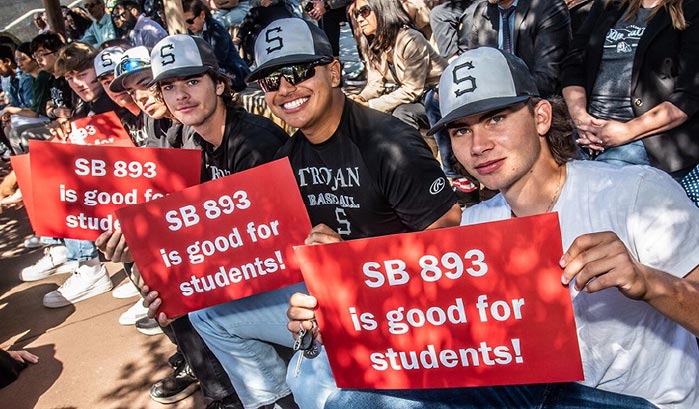
This move was made possible by legislation written specifically for the college district. Senate Bill 893, carried by state Sen. Josh Becker (D-San Mateo) with support from then-Assembly Speaker Pro Tem Kevin Mullin (D-South San Francisco) and Assemblyman Marc Berman (D-Palo Alto), exempts the district from charging the $46/unit enrollment fee mandated by the state. Instead, that money now comes from local property-tax dollars.
Effective through 2027, the law creates a pilot project that its backers hope will persuade Californians to adopt free college throughout the state.
“With all humility, this is one of the biggest changes to improve equity and access that this district has ever made,” said Aaron McVean, district vice chancellor of Educational Services and Planning. “Especially in terms of scope, I don’t think there’s anything we’ve done that has removed more barriers to access.”
So far, the fee waiver has increased enrollment at the district’s three colleges by 10 to 15 percent, McVean said.
A full-time student saves at least $1104 a year, bringing college completion within reach for thousands of county households hit by inflation, by systemic inequity and by pockets of poverty in a region widely known for its wealth.
Community college was free in California until 1984, when funding cuts due to Prop. 13’s cap on property taxes forced colleges to charge $50 tuition a semester.
“It was a sad day,” John Pimentel, a member of the district's board of trustees and fervent supporter of the bill, told the Almanac. As a community college student back then in San Joaquin County, Pimentel himself fought against the fee—which only rose over the years.
Today, the cost to attend community college is “a huge, intimidating and insurmountable wall for many,” Pimentel said. “Dismantling the large, and rising, wall of college costs and breaking down barriers to access is the top priority of our board.”
The tuition waiver took effect in fall 2022, and in March 2023 the District refined its policy. As of the Fall 2023 Semester, the $46/unit enrollment fee will continue to be waived for San Mateo County residents if they have declared an educational goal of a certificate, degree, or transfer with a degree.
Most international or out-of-county students are exempt. However, international, or other non-resident students who are eligible for AB 540 status or for the Non-Resident Tuition Fee Waiver for Undocumented Students are also eligible for SB 893 assistance.
Students who take at least six units each semester of the regular school year, and whose households earn less than 300 percent of the qualifying income for a California College Promise Grant, will have additional fees waived, including student-body fees and materials fees. They may also get financial support for transportation, IT equipment, textbooks, childcare, study abroad and even for their four-year degree.
McVean said the degree- or certificate-path requirement, new to the 2023-24 school year, is key to the legislation’s goal of increasing equity and ending systemic poverty.
“The important message to the student is completing something,” McVean said. “That’s what’s required to achieve some economic and social justice in all this. At the end of the day, if we’re not getting students to a degree, to transfer, or to some kind of career, we’re not helping them.”
McVean said the free college campaign enabled by SB 893 carries forward the mission of the district’s Promise Scholars Program by extending support to many more people. Promise Scholars receive dedicated counseling, financial incentives, and other wraparound support. They are primarily financially needy students who are eligible for the California College Promise Grant. Research shows that Promise Scholars are at least twice as likely as their peers to graduate and to transfer to four-year colleges, lifting not only themselves but their families and communities.
The district has long wanted to enroll every eligible student in the Promise Scholars Program. Yet bureaucratic constraints on funding sources meant that only 2,000 students among the thousands eligible in San Mateo County could be Promise Scholars.
“The issue we kept coming up against was that we could find funding for 2,000 students, but then we’re out of money,” McVean said. “We had to piecemeal the Promise Scholars program together with foundation grants and through fundraising. We knew we could be serving a lot more students if we could use our general fund dollars to pay for it.”
Thanks largely to healthy property tax revenues in San Mateo County, the district set aside $6 million in academic year 2022–23 to support free college.
The Promise Scholars Program is itself an innovation developed in the San Mateo Community College District that was picked up by other California community colleges. Promise Scholars was developed at Skyline College from a successful program at the City University of New York and soon extended to CSM and Cañada.
McVean and his colleagues hope that free college as made possible by SB 893 will also be taken up by the rest of California. A bill that would have allowed community college districts to waive enrollment fees throughout the state died in a Senate committee in 2021.
With support from Assembly members Marc Berman, D-Menlo Park, and Kevin Mullin, SB 893 was passed by a unanimous vote from the State Senate on August 24, 2022, and presented to Gov. Gavin Newsom the following week.
“It’s returning to the original design of free community college,” McVean said. “It’s a new thing, but it’s the same old thing. Let’s see if free community college is the way it’s supposed to be.”
Learn about SB 893 and free college for San Mateo County residents.