Ed Barberini (CSM Class of 1990)
“Formal education is great. But having to struggle a little creates the empathy you need to do this job.”
San Mateo Police Chief Ed Barberini grew up in a working-class family in the county. His folks gave him a solid personal foundation—“Right and wrong was instilled in us,” he says—but college and how to get there were not on the radar.
Stumbling onto College of San Mateo, Barberini discovered a love of learning and social problem-solving that spurred his rise in local law enforcement. As the City of San Mateo’s police chief since 2020, he pays that legacy forward through partnerships with CSM. By contributing to the success of CSM’s Administration of Justice program, Barberini helps ensure that policing in San Mateo County is forward-facing and representative of the community it serves.
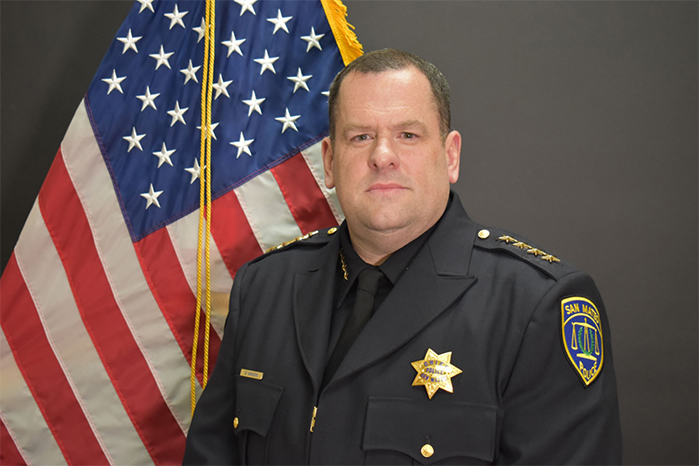
Photo: City of San Mateo
“The reality is that without CSM I wouldn’t have established an education,” Barberini says. “It was an environment that showed me the way.”
He didn’t initially plan a police career. At 17, still in high school, Barberini became a butcher’s apprentice at Petrini’s supermarket on 42nd Avenue in San Mateo. He stumbled on CSM as a way to complete general education classes while working. Having caught the learning bug, he enrolled in more and more courses until he learned from a counselor that he was one course away from an AA in liberal studies.
“This was all before law enforcement,” Barberini said. “You’re 17. You’ve got a job with full benefits ... It’s great, but it’s kind of a narrow view.”
Still working at Petrini’s, Barberini completed his bachelor’s degree in political science at San Francisco State University and then a year of law school. He found the competitive nature of law school didn’t suit him.
“I did really well in law school,” he said. “It was the first thing I really quit in my entire life. It was a little dog-eat-dog, and I think I need relationships. At CSM, we’d help each other and share notes. You’d learn from one another.”
He resolved that whatever his life work became, he would want it to be collaborative and solution-oriented.
“I went out with friends one night and, on a whim, I filled out an application to be a San Mateo County sheriff’s deputy. They called me a year later. I’d forgotten all about it.”
For a while, he worked both the butcher job and law enforcement.
“I remember my very first call ever,” Barberini says. “I was 23 and working in East Palo Alto. It was an argument between husband and wife. Items were flying across the room. These people had been married 56 years. I’m thinking, ‘What do I have to offer these people?’”
“The awareness that I’m out of my depth is a positive thing. Sometimes young people think they can flip a switch.”
Barberini continued learning both on and off the job. He worked in a range of roles over two decades with the San Mateo County Sheriff’s Department, from emergency services to firearms and defensive-tactics instruction to the county jail. He also earned two master’s degrees: one in public administration at Cal State East Bay and a second in Homeland Security studies at the Naval Postgraduate School in Monterey.
“I wanted to be well-rounded,” he says. “I didn’t want to be in a position where I was supervising people whose jobs I didn’t know how to do. Doing those jobs prepared me to do what I’m doing now.”
“I liked Emergency Services,” he says. For three years, Barberini directed fire, emergency medical services, and other crisis response for San Mateo County through the sheriff’s department.
“Those were three years where I didn’t wear a badge,” he says. “I didn’t wear a gun. It took me way out of my comfort zone. But, I learned more in that job than in the rest of my career combined.”
“A lot of the relationships I built then, I rely on today. They provide me with a little different approach to my job; it’s a little easier for me to approach things from a layman’s perspective.”
For two years, Barberini served as police chief of Millbrae on behalf of the sheriff’s department, then from 2015 to 2020 as chief of the San Bruno Police Department. He assumed his current job in February 2020.
Chief Barberini or his appointed representative have been advisers to CSM’s Administration of Justice program. As such, they advocate strong writing skills. The amount of writing needed in policing is huge, Barberini says, from documenting cases for prosecution to obtaining search warrants.
It takes two years to become a police officer, Barberini says, starting with six months in the police academy. Communication skills and commitment are key to going the distance, and these skills can be honed at CSM.
“Most of our candidates pass the police academy,” Barberini says. “We lose most in field training. The biggest thing is communication.” CSM stresses verbal and written skills in the Administration of Justice program, which sets a sound basis for student success in law enforcement.
Barberini’s department recruits at CSM, partly because the student body is representative of the county and partly because a successful college career demonstrates grit.
“We’re looking for a workforce that mirrors those we serve. We want to better interact with our communities. CSM is representative. So it’s an ideal place for us to recruit,” Barberini says.
“At a minimum, we want 60 units,” Barberini says. “Formal education shows me there’s a commitment. When you’re 18 or 19, if you don’t go to class, no one’s going to know. You’re there because you’re looking to better yourself.
“On the job, I know you’ll manage your time well. You won’t panic.”
Michael Brunicardi, associate professor of administration of justice at CSM and a former area lieutenant in the San Mateo Police Department, calls Barberini’s involvement a “win-win.”
“Our philosophies mirror each other’s,” Brunicardi says. “We each embrace critical thinking, problem-solving and philosophies of community policing. Part of our curriculum at CSM emphasizes developing relationships with the community we serve. Together, we identify problems and develop long-term solutions that will ultimately improve the quality of life in our neighborhoods.”
One of Barberini’s mentorship programs involved the CSM football team.
“We met with the players after the George Floyd incident,” Barberini says. “Coach Tim Tulloch and I have come to know each other pretty well. We thought, ‘This is something we can do for them.’” Barberini had players shadow his officers on patrol. Some of the players got interested in law enforcement careers. In fact, Barberini says, he recently hired a former Bulldog who went on to graduate from Washington State.
As well as his own involvement, Barberini grants his officers release time to make presentations to CSM students. CSM, in turn, partners with San Mateo PD’s recruitment captain on hiring practices.
Barberini and Brunicardi also collaborate on police cadet and Explorer programs. Many participants are students at CSM. The Explorer Academy gives young people a foundation in the profession with ride-a-longs in patrol cars, while a cadet is a police volunteer under 21 years of age who may help with tasks such as traffic control at events. Both programs fit into CSM associate degree coursework.