CSM’s First Chinese Student
Li-Yan Zhu ’82 didn’t mean to make college history, he just wanted to become an engineer
For the last 40-plus years, students from the People’s Republic of China have been a large and valued segment of College of San Mateo’s international student enrollment. This wasn’t always so. It took President Richard Nixon’s normalization of diplomatic relations in December 1979 between the United States and the People’s Republic of China (PRC) to pave the way for trade initiatives including higher education. It also took a bold contingent of Chinese students who didn’t mind breaking new ground to live and study in the States.
In 1980, soon after the fall of the so-called “Bamboo Curtain,” CSM President Lois Callahan hosted a group of Chinese education officials who were evaluating possible placements for students. Months later, future engineer Li-Yan Zhu was the first of eight PRC nationals to join the student body. He chose CSM because he had an uncle living nearby who could sponsor his visa.
“Coming to the US was the most difficult part,” Zhu recalled. “It took the right timing and connection. China had just opened its doors then, and my family just got hold of my uncle in Millbrae, who was willing and able to sponsor my education.” Zhu credits CSM with greatly improving his English and preparing him for the University of California, Berkeley, where he transferred in mechanical engineering and earned his doctorate in 1988.
Though he and other young Chinese were raised to think of America as their country’s ideological and social opposite, Zhu said he found surprisingly little culture clash.
“I was surprised how similar the two cultures are,” said Zhu, now 66 and living in San Jose. “I was taught in China that ‘labor is glorious.’ Then I learned in my first CSM class that ‘without labor, nothing prospers.’”
CSM has always had international students, due in part to its place on the Pacific Rim and its proximity to San Francisco, a center for global trade. In 1965, two years after College Heights opened, Ruth Smith and social science instructor Howard Durham created CSM’s Foreign Students Center to handle an increased enrollment at the larger new campus. Smith’s official title was Foreign Student Assistant, and her official job was processing visas, work permits and extensions of stay.
Yet the actual work was both much broader and far more personalized. Just as CSM’s much larger Center for Global Engagement does today, Smith worked hard to welcome global students to the States and to introduce them to a new way of life.
“Mrs. Ruth Smith was very kind and caring to foreign students,” Zhu said. “She held parties often in her home, to bring students from all over the world closer. She was also helpful answering questions, to help foreign students finding their way.”
Smith’s father was a Danish immigrant, and she considered her immigrant heritage the initial impetus for her work. She had a plaque on her desk with a Mother Teresa quote: “Do small things with great care.”
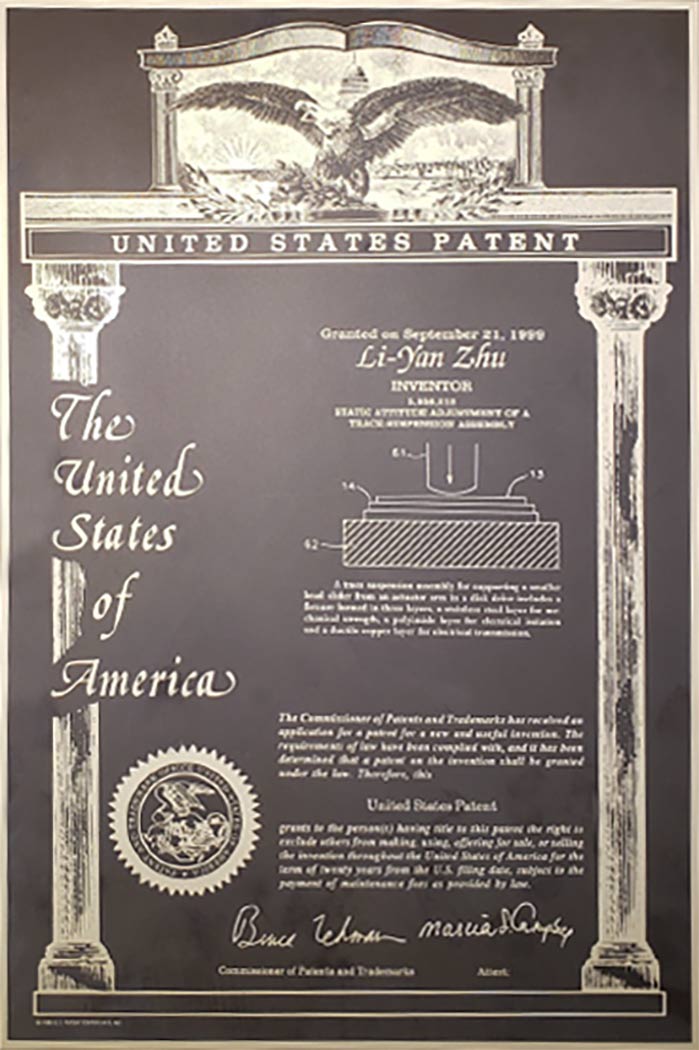
A plaque of one of the 39 U.S. patents that CSM alumnus Li-Yan Zhu was granted in his career. Photo courtesy Li-Yan Zhu
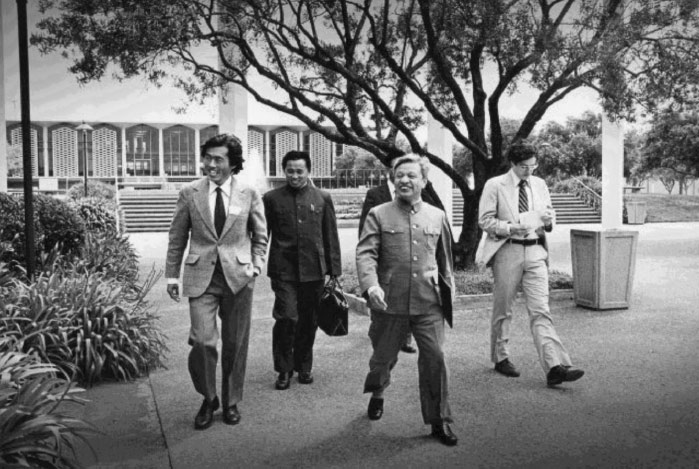
CSM electronics Professor Peter Wang, left, shows visitors from the Chinese Ministry of Education around campus in early 1980, just weeks after diplomatic relations opened between the United States and the People’s Republic of China. Future inventor Li-Yan Zhu became the first Chinese student to enroll. Photo: CSM Historical Photo Collection
Zhu says he always believed he would become an academic success. “There was never a doubt in my mind,” he said. “I did well at high school in China, and I was willing to try harder here in the United States.
He became an engineer because, even as a youngster in China, he loved tinkering with things. “Among many of my hobbies, tinkering with hardware is the most expensive,” he said. “Being an engineer allows me to play with purpose and resource.”
Zhu’s PhD dissertation investigated “Measurement and Analysis of the Slider-Disk Spacing in Magnetic Recording and Files.” Zhu’s 39 patents tackled mechanical, electrical, and magnetic issues in the design, manufacture, and testing of two popular products—disk drives and lithium-ion batteries.
Born and raised in a rural area in southern China, Zhu had spent quite some time in his childhood gathering and chopping wood for cooking. He experienced firsthand that as the hills were deforested, it was increasingly more difficult to gather firewood. He also saw that soil erosion, flood, and drought became more frequent and more intense as tree cover was lost.
As a result, Zhu for years has spent much of his free time developing the most efficient possible ways of optimizing solar cooking instead of firewood for household use. While some cookers get very hot, they need to be trained toward the moving sun every few minutes. An unattended solar cooker reflector also poses a fire hazard. In Zhu’s approach, he takes the best qualities of box cookers and parabolic cookers and combines both into one design, a deep parabolic solar cooker that is easy to make and can be used for unattended cooking.